

The Next Chapter - Part 3: "Toward a Geography of Trust"

In the last blog, I wrote about the three kinds of trust identified by Bryk and Schneider in their foundational book about trust in schools. I remarked that the erosion of relational trust I was feeling over the last decade, through four different heads of school, may actually have been a pivot within the school from relational trust to contractual trust.
One reason as to why this shift is occurring may have to do with how vulnerable a reliance on relational trust places those within asymmetric power relationships. As part of the very definition of relational trust, one party (students or teachers) may be vulnerable to the other (teachers or administrators), and trust can be built when the party with the preponderance of power puts the other more at ease. Most educators believe that learning itself is an activity that requires putting the student constantly in the vulnerable position of not knowing, and then nurturing teachers promote the development of confidence, resilience, and in some cases “grit” within these vulnerable moments. However, such an environment, especially involving young people vis a vis adults, is rife with opportunity for abuse, and there have been many cases of misconduct (including at my former school) in which an environment that was rich with relational trust was exploited by an untrustworthy actor. A single bad actor can undermine the trust an entire community has for an institution.
Schools have responded to the risk with professional development trainings and through the introduction of robust codes of conduct and “safe spaces” practices. At my former school, these trainings, while they were always in place, were recharacterized from being a preventive and prophylactic measure to being corrective, even punitive, and underscored to the greater community as a means to rebuild its confidence in the school (even though the malefactor was no longer in our community). Protocols and codes were made more robust and spotlighted for the community constantly and at the beginning of the year for employees when the handbook was distributed. There was a feeling that the safety of the students was guaranteed less and less by the care and concern of the teachers and staff, and more and more by the leadership and policy of the administration.
These protocols and codes provide the means against which behaviors, responses, and practices in the classroom can be measured and evaluated like a service or product delivered by a corporation or institution. In this manner, teachers are ever more becoming akin to doctors, who, as Bryk and Schneider write “... undertake open-heart surgery to correct a cardiac problem. Even though the patient’s condition might not improve as much as desired, the appropriateness of the chosen procedure (that is, the particular surgical technique used) and the adequacy of its execution can still be established” (19). While Bryk and Schneider did not believe this kind of trust rooted in specific procedures characterized the school setting, I argue that the privacy of classrooms is falling more and more under the oversight of the administration, and students are more likely to flag material, activities, comments, and practices by teachers as inappropriate, and administrators are likely to take these reports more and more seriously. Whereas Bryk and Schneider assert that contractual trust does not apply to school settings because “no easily accessible records exist from which it is possible to determine what is actually taught and how well it matches school aims and acceptable teaching practices” (19), students (and parents) have been given an evaluatory role to increasing degrees, and they are encouraged to report what they perceive as violations, transgressions, and inappropriate conduct on the part of their teachers. Such reports include both whether or not subject matter is appropriate (or even considered useful), the approach to teaching such material, as well as whether or not a student feels uncomfortable or unsafe in the classroom. Students are even provided apps for their phones so that they may document, film, or record incidents that they deem to be in violation of “safe practices.” Interestingly enough they are placed in the role of surveillance of their own experience as students. We will return to the idea of the classroom as a “safe space” often in this series as we move toward what I am beginning to believe is an examination of the geography of trust with its further removal from the good intentions of individuals in favor of a specific set of codified guidelines and boundaried roles within carefully delineated spaces.
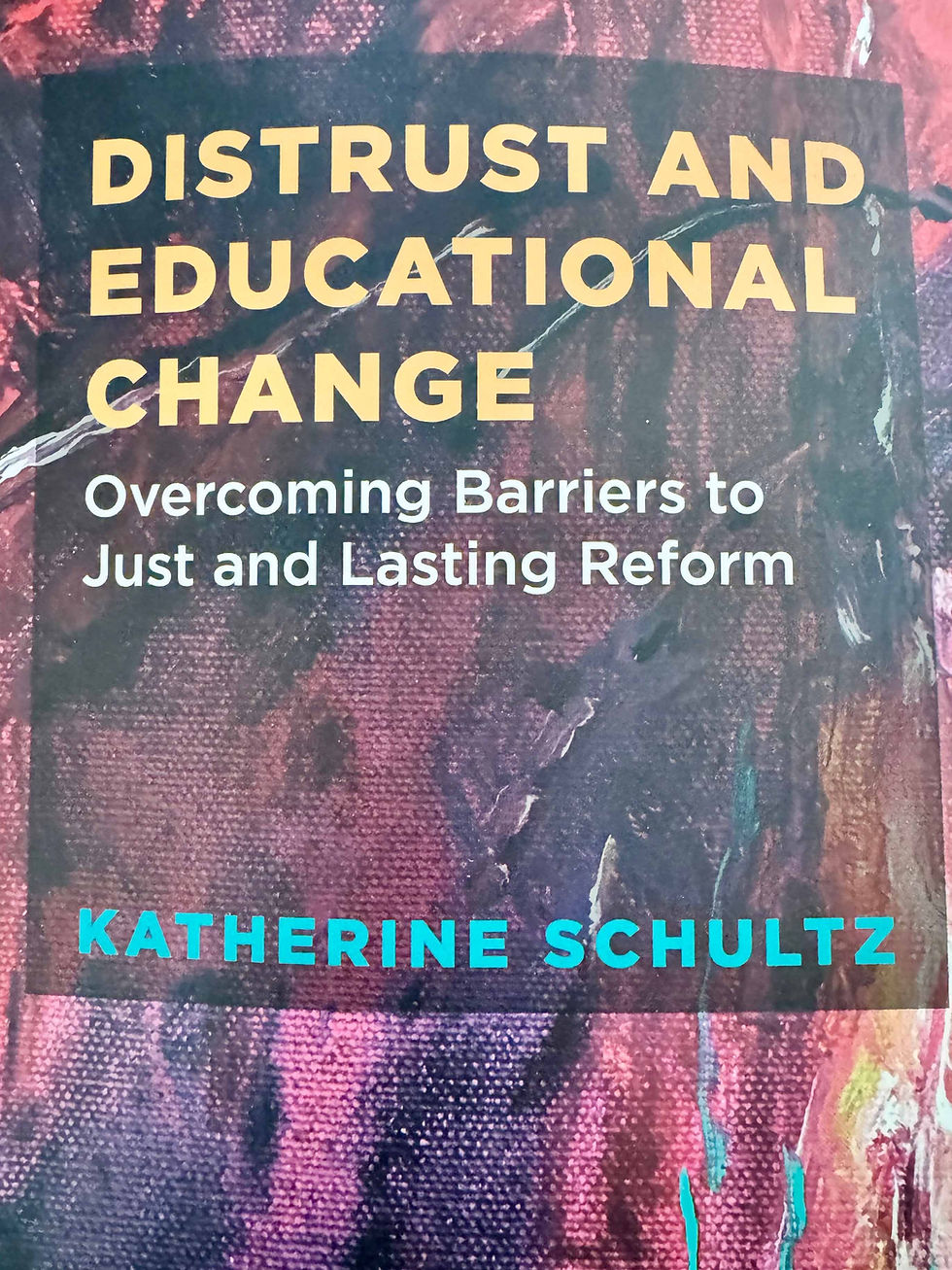
For now it is my aim to briefly look at the school environment (I acknowledge my experience is with an independent school) from the alternative perspective provided by Katherine Schultz in her 2019 book Distrust and Educational Change. Like Bryk and Schneider, Schultz begins by dividing distrust into three different types: relational, contextual, and structural. Unlike Bryk and Schneider, who found that only one type of trust could characterize the school environment, Schultz argues that all three in this tripartite model have eroded relationships within schools. In particular, she examines schools in American settings such as Oakland, Chester, and Chicago, but she also includes a case study based on her experiences working with school principals at schools in Palestinian refugee camps in Lebanon.
The book begins by examining why educational reform is so difficult, and immediately links the distrust to the falling test scores, which coincides with a change in how teachers are perceived: “Teachers were once almost universally trusted by their students’ parents. Today, all too often, teachers feel distrusted by both parents and administrators” (11). This distrust proves to be more than merely a lack of relational trust. No amount of trust building circles, she argues, can bandage the gap that is ever widening between students, families, teachers, and administrators. The thrust of her argument is that while trust is mainly a relational quality between individuals (as has been described in our discussion of Bryk and Schneider), distrust is more multidimensional in that it can be relational, but it can also be structural and contextual. Each of her main case studies focuses on one kind of distrust.
In the second chapter of her book, Schultz reviews the educational policies of superintendents in the Oakland Unified School district from 2000 to 2017. She often views the changes from an outsider perspective, but she mentions that this is augmented by her role as dean of the School of Education at Mills College from 2010 to 2014, when she co-led the Oakland Education Cabinet with Superintendent Tony Smith and Mayor Jean Quan. Through various different superintendents, which included a state takeover from 2003 to 2008. The superintendents all experienced different levels of relational trust with their communities. Schultz concludes:
It is essential for all stakeholders to understand that trust can’t simply be acquired through words, as one district official might have hoped when he asked his teachers why they did not trust him. Building trust and addressing distrust depend on mutual actions and authentic opportunities for collaboration, not simply conversations and discussions. The process also depends on respect for teachers, community members, and students as people with relevant expertise. The distrust and disrespect experienced by the teachers and principals, as well as by the students, made it difficult for the school administrators or the district to enact the innovative change they sought. Any kind of lasting transformation depends on addressing and ultimately dispelling distrust, a process that cannot proceed quickly, and must address the historical relationships and political realities on which relational distrust is almost always grounded. (38-39)
From the initial discussion of relational distrust of individual superintendents (largely seen as outsiders with their own personal agendas), we can see caused it is intertwined with two other kinds of distrust, structural and contextual, and this makes creating trustworthiness infinitely more complicated than what trust building activities can hope to accomplish. Shultz writes:
Structural distrust is connected to local politics and consequential decisions made by politicians and others in authority. Structural distrust is embedded in hierarchies and bureaucratic structures or policies and is characterized by an imbalance of power that undermines participation by local communities. This type of distrust often stems from top-down decisions… Contextual distrust arises from local interactions that have persisted over time, often between members of various ethnic and racial groups, and is also inflected by power. It is situated in the sociocultural, historical, and political contexts of schools and communities. (4)
The case study of Chester, in the suburbs of Philadelphia, where the author served as a school board member from 2007 to 2010, demonstrates how efforts to build relational trust between the board and the community resulted in many accomplishments during the few years as a governor-appointed board charged with turning the struggling district around, including stabilizing the budget, holding the number of students going to charter schools steady, which was accomplished by improving the public schools, forming a partnership with a private funding group to open a public school focused on the arts, opening fifteen preschool programs, building playgrounds, creating libraries, hiring new teachers, and much more. These changes were immediately dismantled when a locally elected board took over control from this governor-appointed board on which she served. Schultz writes that the changes were ephemeral because relational trust had only been built with activists who supported the district-run schools (as opposed to families that wanted “pro-choice” charter schools) and that the board had been forced on the district from the outside by the state. The community as a whole had felt that the changes had simply been forced on them from outsiders who thought they knew better what Chester needed than the people of Chester. Adding to the top-down, outside-inside approach, was the political suspicion that the largely Republican community had for the program initiated by the Democrat governor. Compounding the distrust created by the top-down approach were the contextual factors caused by what the community ultimately saw as ignorance on the part of the appointed board:
All of our interactions with individuals and community groups, including their distrust of us, were shaped by the history, politics, and sociocultural characteristics of the city and district. The district had a long and some would say intractable, history of decline along with a narrative of a vibrant past. (63)
The contextual distrust alluded to here, a total disregard for the past successes of the school, grounded the board in the minds of community members as seeing only the failures and deficits that currently plagued the district. Community members were left feeling like the board was imposing programs and measures on them in a way that suggested they didn’t feel that the community was capable of imagining for themselves or, even worse, that they hadn’t tried such measures in the past. Such an ignorance of context is illustrated further in Schultz’s next chapter based on her experience doing professional development workshops for principals in Palestinian refugee camps. Here the deep-rootedness of lateral gaps between the individuals that were present in the workshop was quite insurmountable, as these principles represented schools from different political, religious, and even militant-group affiliations. Trying to force a trust building activity between members of different militant groups even resulted in physical confrontations although some activities, such as writing poems about their shared homeland, Palestine, did result in moments of relational trust.
The message that emerges from Schultz’s book is that in order to build trust, activities that cultivate relational trust are not enough to bridge the disparities caused by contextual and structural sources of distrust. To move past these obstacles, these sources of distrust must be directly acknowledged and made explicit. Success with this doesn’t merely result in pure relational trust, either. Schultz believes that the path to assuaging the discomfort, unease, and downright feelings of being unsafe, actually involves much more than trust building and trustworthiness: it involves the fostering of dignity within the various groups that are represented.
In the fifth chapter of her book, Schultz gives a whirlwind tour of the history of education through the lens of distrust, and what emerges is the danger that is present when reforms, improvement programs, and professional development are presented as being a logical response to a deficit of some kind. The two largest movements for educational improvement fall under two categories: the progressive “education for all” movement and the later birth of the neoliberal, “pro-choice” (privatization) movement.
The history of the progressive movement begins with Horace Mann in the early 1800s, when, as the secretary of the Massachusetts Board of Education, he characterized schools as the very site where the United States was to produce the equality that it promised in the Constitution. Schools would be the “great equalizer among men” (98). Mann argued that the unequal opportunities that existed informally for the wealthy should be publicly funded and available to all. Children from all backgrounds sitting next to each other, learning together would realize the vision of a democratic society where there was opportunity for all. Thus each of the educational reforms aimed at increasing equity finds its roots in Mann’s progressive vision. The neo-liberal reforms, beginning shortly after Brown v. Board of Education (1954), focus on another important tenet of democracy – free choice. Ironically, some of the earliest schools that promoted choice for families involved the withdrawal of white families from schools that had previously been all white and, with those all white public schools becoming de-segregated, the white families flocked to all white private schools. Neither one of these movements, as Schultz illustrates, has resulted in lasting change because they are both rooted in deficit perspectives and they fail to address the underlying causes – the pervasiveness of poverty and structural racism.
Schools have been hailed simultaneously as the solution to inequity and the very site where equity has failed. Schultz writes:
… there remains a persistent belief in the United States that schools are critical to curing societal ills by “promoting social mobility, creating national harmony and building solid citizens.” For instance, during his enactment of the the Great Society initiative designed to end racial injustice and poverty, Lyndon Johnson proclaimed that: “The answer for all our national problems comes down to a single word: education.” (97)
Then Schultz goes on to write about the very reform movements aimed at realizing Mann and Johnson’s goals:
Despite their different political and educational agendas, however, both progressives and neoliberal education reformers have generally defined, diagnosed, and sought to address the essential challenges to public education through deficit perspectives. These perspectives have, in turn, led to the distrust and blame… that have prevented lasting change. There are numerous examples in the last two decades alone of how new reforms or directions for educational change have begun from this stance. In his first speech on education, President Barack Obama bemoaned the fact that “despite resources that are unmatched anywhere in the word, we’ve let our grades slip, our schools crumble, our teacher quality fall short, and other nations outpace us.” Likewise, President Donald Trump proclaimed in his [first] inaugural address that “beautiful” students are “deprived of all knowledge” by the “cash-guzzline schools” in our country. His secretary of education, Betsy DeVos, has repeatedly labeled public schools as a “dead-end” bureaucracy, claiming that unionized teachers “care more about a system, one that was created in the 1800s, than they care about individual students.” (99)
Inevitably the deficit perspectives attacking the education system’s failure to deliver on its promises of equality and equity locate the blame in three places: the families that do not prepare their children adequately for school and do not support them through it, the teachers that care more about their jobs than the students they teach, and the inefficient bureaucracies that plague the administrations (which would be better off privately run in the case of public schools). These cycles of blame and distrust characterize the various movements aimed at equity and equality in schools during the last seventy-five years. Though often characterized as a lack of relational trust for students, families, teachers, and administrators, caused mainly by top-down approaches to addressing inequality, the label of relational distrust, according to Schultz, actually elides the true barriers to change and reform: contextual and structural distrust.
The deficit views were bolstered by three prominent, national moments of intense, public panic. The first was the 1957 Sputnik launch by the Soviet Union, which caught the education system up in the space race. The public was afraid that American children were being held back from high achievement by a perceived deficit in the teaching of math and science. One of the results of this was the New Math program, which was a short-lived failure ultimately deemed too difficult and too conceptual. A second wave of panic was caused by the publication of a 1983 report called A Nation at Risk, which made claims such as “the educational foundations of our society are presently being eroded by a rising tide of mediocrity that threatens our very future as a nation and a people” (in Schultz 108). Ultimately, teachers were being blamed in the report for the feeling that America was losing ground on the global stage. And finally, the capstone (or nail in the coffin) was the 2001 No Child Left Behind which not only blamed teachers and schools but punished them when their students did not perform satisfactorily on standardized tests.
Throughout Schultz’s discussion schools are treated implicitly and explicitly as spaces and sites where hopes are fixed, where contestations occur, and where blame is assigned. They are settings for narratives such as the story of equality and freedom, the story of America as a land of opportunity, and, of course, the story of our failure to live up to these dreams and to even keep pace with other countries. Schultz is explicit when she points out that often the space of the school is cut off from, or separated from the community in which it is embedded, which is the precondition for contextual distrust. She also links these spaces to structural distrust when they are managed externally whether by the state, or by a private sector (such as when charter schools have formed alliances with Bill Gates, Mark Zuckerberg, or the Walton family) (113).
One of Schultz’s proposed solutions to ending the cycle of blame and distrust (as a result of deficit perspectives) is to create spaces that promote dignity within the schools. She provides two examples where reform has been successful: the Oakland International School, where the entire student body is comprised of immigrants (many of whom are unaccompanied) from about thirty-five different countries, and Urgent Art, an afterschool program that provides youth with tools and media to tell their stories. Both of the successful approaches to education feature teachers as facilitators to student storytelling. At the Oakland International School, the school implemented a practice called “community walks” in which students introduce the teachers and staff to their home communities and cultural knowledge. The Urgent Art program (also in Oakland) encourages students “to make powerful statements in a range of media to represent their experiences, beginning to address the contextual distrust they have experienced when they hid in their home countries [rather than merely attempting to build relational trust], afraid to go to school because of threats made by gangs, or their precarious journeys to the United States” (136). Schutz writes:
Each of the examples in this chapter illustrates ways to address the distrust that impedes educational change: recognizing the capacities of teachers to lead their own professional development; engaging the community in crafting reform strategies in contrast to top-down approaches; creating schools and educational spaces that preserve the dignity of youth and adults who work there; and building change based on the capacities, experiences, and knowledge youth bring to school. (137)
Schultz finds the answer to distrust in honoring the knowledge of teachers, in recognizing the students’ capacity to learn, in building solutions with the community defined much more broadly, in avoiding the imposition of solutions on people, and, most importantly, in creating spaces that promote people’s dignity. Ultimately, the path to dignity is to create spaces, to use Schultz’s language, that provide room and time for stories: “Listening to stories, especially those that represent multiple perspectives, is critical to addressing all forms of distrust, especially contextual and relational distrust” (141).
In fact, if we look back over Schultz’s work, we may conclude that distrust has constantly been about the suppression of multiple stories and the privileging of one. The suppression of these multiple stories is, I would argue, at the root of how Schultz characterizes contextual distrust. The example to highlight contextual distrust was the workshop she co-led in Lebanon in which there were principals from schools that were affiliated with different religious and political groups within a refugee camp in Lebanon. Each of these groups had stories they told about their own groups vis a vis the other groups, yet the approach to building trust was to perform a poetry writing activity that essentially focused on a single story of alienation from their homeland, supposedly a story that was shared by all groups. After a successful first day in which she felt they had established some relational trust, the contextual distrust that erupted in physical altercations in later sessions, she notes, was a result of her lack of recognition of these competing stories that better capture their individual experiences. In retrospect, she feels that she would have been more successful if she had spent time acknowledging the contextual distrust, and, I would add, this could have been accomplished by providing a space in which to tell a multiplicity of stories along different themes.
Schultz’s case study for structural distrust involved the Chester school where those attending the board meetings, which were also disrupted by outbursts but did not lapse into physical altercations, was also, to a certain degree, affiliated with the lack of the governor-appointed board to acknowledge the story of a vibrant past in the school in favor of the history of decline more recently experienced in the district. In the very last paragraph of her book, Schultz mentions the well known TED talk given by Chimamanda Ngozi Adichie about the dangers of a single story. Adichie links the “single story danger” not only to stereotyping a people or place, but also, in telling the story of someone else or somewhere else, to an exercise of power over those people or that place. Schultz was struck by the statement by one of the parents at her first public board meeting. The parent said to her and the other governor-appointed board members, “You are plantation owners.” Schultz rationalized this, since the appointed board included African Americans, as being a response to the fact that the board arrived from the outside and was making decisions that the community of Chester would have to live with long after the appointed board was gone. I would add that this community member was responding to the blame they were feeling as a result of the deficit perspective of the school (that it was underperforming). The story of the vibrant past that might have empowered the community was occluded by the narrative that maligned the school, thereby robbing the community of its dignity.
While Adichie’s 2009 TED talk is only mentioned at the end of the book, the logic of Schultz’s book closely follows that of Adichie’s presentation. The thesis of the TED talk is that telling a single story about a people or a place robs that culture or place of its dignity. Adichie’s “idea worth spreading” is that we must, as Chinua Achebe famously stated, celebrate a balance of stories. Otherwise we not only perpetuate stereotypes of people or places, but also, through the flattening of the experiences of those people and that place, any understanding will always be incomplete. Schultz extends the argument that single stories that malign a people and dispossess them of their dignity breeds distrust, which in the case of school communities forms a formidable barrier to improvement or lasting change of any kind.
Here I would like to pause and take stock of where I am in this discovery process. In this blog, I have discovered that I can characterize the same changes I experienced at my former independent school in different ways. In the first blog I noted the rising feeling of strain between the administration and the faculty. In the second, I describe the changes as stemming from the deep shift in the nature of trust from it being relational to it being contractual. Finally, here I link the changes I felt to a response to a deficit perspective (the single story that my former school did not protect students adequately), the feeling of blame it engenders, and the multidimensional distrust that can become pervasive within a community. As I move forward, I am interested in exploring how the creation of “safe spaces” and “strong boundaries” as a means of school improvement interacts with, at times reinforcing and at times eroding, relational trust. The co-existence of relational trust (formed organically through an abundance of care and concern) with the aim to make students and fellow colleagues feel safe, are, I believe, at times aligned with one another and at others, at odds with one another. I am particularly interested in how storytelling fits into this complex interaction, and how telling multiple, sometimes even contradictory stories can be deployed in the face of single, powerful deficit narratives to foster, nurture, and possibly restore dignity. Importantly, I want to emphasize that I do not think these deficit narratives are invalid or untrue. I only want to reiterate what both Adichie claims in her TED talk and Schultz argues in her book: these single stories – deficit narratives – are incomplete, and they are deeply interwoven with the distrust to whatever degree a school or community is experiencing it.



Comments